2010年9月21日 星期二

Educational Trip -- 國際教育旅行 (日本 02):共 4 组

圖片編號:001
Taken in Nov. 2003, in Tokyo Disneyland --- 2003年11月攝於東京迪士尼!
(They were celebrating the 20th anniversary of this great amusement park.)


圖片編號:002
遊覽 蘆 之 湖 . . . . . . What a beautiful lake, Lake Ashi!


遊覽 箱 根 神 社 . . . . . . The Hakone Shrine!

A Note: The Hakone Shrine (箱根神社) is a Shinto shrine in the town of Hakone in Kanagawa Prefecture (神奈川縣). Japan. It is also known as the Hakone Gongen (箱根権現). It is located on the shores of Lake Ashi (蘆之湖). The main festival of the shrine is held annually on August 1.


攝於 箱根神社 . . . . . 合影留念!
This following photo was taken on 19, Nov. 2003. Some other members of our tour group were not included, as they were strolling too far away to explore this big and beautiful area.


圖片編號:003
「國際教育旅行」學生交流照片----所拍為數甚多,僅「象徵性」提供下列三張!
These pictures remind me of our happy visit to The First Commercial High School, in Tokyo.
Can you imagine how the students at FCH welcomed us when we visited them?


圖片編號:004
成田山新勝寺 (Naritasan Shinsho-ji Temple)
We were lucky enough to see the monks' procession -- I was very impressed by the colorful apparel (clothing) that the monks were wearing. The red umbrella was an eye-catcher, too.


附註:新勝寺位於日本千葉縣 (Chiba Prefecture) 成田市 (Narita-shi),供奉本尊不動明王。自西元 940 年開寺以來,已成為日本最具代表性的寺院之一;以建造於通往本堂石梯上的「仁王門」及建於本堂右前方的「三重塔」為首,寺院內有為數眾多的建築物被指定為重要文化財;從這裡並可細細體會江戶中期到後期,建築物所展現的莊嚴氣氛。


- - -


2010年9月20日 星期一

Educational Trip -- 國際教育旅行 (日本 01):共 5 组

圖片編號:001
我最滿意的作品之一:《理想與現實》
A masterpiece of mine: "Ideality vs. Reality"


背景為日本第一高峰---富士山 (ふじさん, Fuji San),海拔 3,776 公尺,山頂終年積雪。北麓五個堰塞湖(富士五湖:山中、河口、西、精進、本棲),映照著皚皚白雪,湖光山色,風景幽美,是日本的遊覽勝地。在日本人的心目中,富士山有其獨特的文化和宗教象徵;許多日本的宗教教派將富士山視為聖地。此外,自古以來,日本人不斷藉由藝術和文學推崇富士山,因此富士山經常是文學和藝術作品的主題或背景。

Mount Fuji is the highest mountain in Japan at 3,776 m (12,388 ft). In English, it is also known by the native Japanese Fujiyama and Fuji-san. The mountain is surrounded by five lakes: Lake Kawaguchi, Lake Yamanaka, Lake Sai, Lake Motosu and Lake Shoji. They, and nearby Lake Ashi, provide excellent views of the mountain. Mount Fuji's exceptionally symmetrical cone is a well-known symbol of Japan and it is frequently depicted in art and photographs, as well as visited by sightseers and climbers.

自古以來,這座山的名字就經常在日本的傳統詩歌「和歌」中出現。在《竹取物語》中,許多武士將長生不死的靈藥在最接近天的富士山上燃燒,因此,這座山名為「富士山」、「不死山」或「不盡山」。(日語中,「不死」和「不盡」的發音都與「富士」接近)

The origin of the name Fuji is unclear. A text of the 10th century Tale of the Bamboo Cutter says that the name came from "immortal" (不死, fushi, fuji?) and also from the image of abundant (富, fu?) soldiers (士, shi, ji?) ascending the slopes of the mountain. An early folk etymology claims that Fuji came from 不二 (not + two), meaning without equal or nonpareil. Another claims that it came from 不尽 (not + exhaust), meaning neverending.

然而,聖山之前,為何要有如此突兀的 電 線 桿?
Why, then, do we need such an awkward pole before the Holy Mountain?


圖片編號:002
美哉!東京的「彩虹橋」
What a pretty bridge! The Bridge of Rainbow, in Tokyo!


圖片編號:003
東京電視台 + 雛菊花田 = 剛柔並存、陰陽調和!
Tokyo TV station plus little daisies in the field makes me
think of Ying and Yang in the Chinese philosophy.


圖片編號:004
My former superior Principal Shulin Lee, who led us to Japan in 2003 for the first time.
李述藺校長(原南投高商校長)於2003年第一次帶領我們
(南投縣高中職校 80 多位師生)赴日本教育旅行


圖片編號:005
這張背光的照片,就是「木咕子的家」中,我用來自我介紹的那張。

The bright sun setting behind me made me almost unrecognizable;
however, I like this photo so much that I've used it for my blog(s)


2010年9月17日 星期五

Sentences from Ten Ancient Scrolls

#2010-0917

Following are ten sentences from the so-called "Ten Ancient Scrolls," which are Chapters 8-17 of The Greatest Salesman in the World written by Og Mandino:

 1.  I will form good habits and become their slave.
 2.  I will greet this day with love in my heart.
 3.  I will persist until I succeed.
 4.  I am nature's greatest miracle.
 5.  I will live this day as if it is my last.
 6.  Today I will be master of my emotions.
 7.  I will laugh at the world.
 8.  Today I will multiply my value a hundredfold.
 9.  I will act now.
10. I will pray.

The first of the above sentences is quoted from Chapter 8: The Scroll Marked I. The second sentence is from Chapter 9: The Scroll Marked II. The third, from Chapter 10: The Scroll Marked III; the fourth, from Chapter 11: The Scroll Marked IV; and, in the same way, the other sentences are from Chapters 12-17 (The Scrolls V-X) respectively. Well, from each of the ten "ancient scrolls" I've just taken one sentence, just like the topic sentence, which is simply-worded but very, very meaningful.

I like these ten sentences very much. I can recite them quickly and clearly in the right order. And, you know, for more than twenty years I've been repeating them as my favorite mottoes!

The novel The Greatest Salesman in the World has had several Chinese translations (although I haven't seen any at local bookstores for a long time).

I remember buying the version translated by Ms. Liu Pinghua (劉蘋華). I bought that particular version for three times at least, because I considered it the best-translated, and because . . . . Well, I've given out all of the Chinese versions that I bought as gifts, one of which I gave my younger sister living in Caotun!

If my memory serves me right, the above ten sentences are put into Chinese by Ms. Liu Pinghua as follows:

 1.  我要養成好的習慣,做它的奴隸。
 2.  我懷著滿心的愛,向今天致意。
 3.  我將堅持到底,直到成功之時。
 4.  我是自然界最偉大的奇蹟。
 5.  即令今天是我最後一天,我也要好好度過。
 6.  今天我要做我情緒的主人。
 7.  我以滿心的笑意,迎迓眼前的世界。
 8.  今天我要增加我百倍的價值。
 9.  我現在立刻就做。
10. 我心祈求。

The Lord bless all readers of these valuable quotations. Amen.


Footnote:
According to Wikipedia, Mandino composed The Legend of the Ten Scrolls. They are:

    Scroll I - Commitment
    Scroll II - Love
    Scroll III - Persistence
    Scroll IV - Miracle
    Scroll V - Time
    Scroll VI - Emotion
    Scroll VII - Laughter
    Scroll VIII - Value
    Scroll IX - Action
    Scroll X - Guidance

Mandino's primary message was to "do it now." In the marking of Scroll IX, "I will act now" is written 18 times. While his messages did have Christian undertones (by referring to Paul as the greatest salesman in the world), it was still a message of repetitive actions to build good habits.

- - -

2010年9月15日 星期三

溪頭剪影(夜行晨走新山客)

圖片編號:001
Jean and I visited Xitou (or spelled Sitou) on September 14-15, 2010.
While staying at The Youth Activity Center for the night, we took an easy walk nearby.


Suddenly we came across something jumping -- See, is it a frog? Or a toad?
差一點兒踩到牠 ---- 請仔細看,這是青蛙?還是蟾蜍?


And what is this? It looks like . . . . But it can change its "shape" when you touch it with a stick!
用手電筒照,牠像一條直彈簧;用手杖輕碰一下,牠馬上捲縮
變了形狀。 --------- 這 又 是 什 麼 東 西 ?


Then, when it starts to move again, it turns to be a question mark(?) without a full stop (.).
牠終於解開心防,再度動身向前行;那樣子,活像一個沒有尾點 (.) 的問號 (?)。

【補註:牠應該是一種叫做「馬陸」或「千足蟲」(millipede) 之類的東西吧!】


圖片編號:002
迎著晨曦,我們緩步走入「森林浴步道」;沿著這條標明「挑戰級、3,000M」的崎嶇
山路,我們緩慢向上、向前,直到........著名的「神木」;然後回程,經過所謂
「空中走廊」,走另一條「觀景步道」,回到「大學池」附近
歇 腳 、 用 餐 。 啊 ! 身 心 愉 快 !


圖片編號:003
Because . . . Jean and I have decided to come and visit Xitou as often as we can.
因為 . . . 我倆已決定常常來溪頭,來造訪這裡的每一條步道。


2010年9月14日 星期二

溪頭剪影(池畔讀經忽見僧)

圖片編號:001
九月14、15日,與妻同遊溪頭:這是「歸回田園」之後
頭一次「出遊 + 外宿」,我倆的心情 愉快之至!


圖片編號:002
置身「大學池」畔,除了重溫舊夢,我們也編織 美麗的 新希望!
We're weaving our new hope, new and BEST vision . . . here at University Pond!


圖片編號:003
在風光明媚的「大學池」畔,唸一唸《大學》《中庸》如何?
我卻邀來我的另一半,同讀《聖經》中 最令我感動的一段! 
It's really wonderful to read the Bible in such a beautiful place.


圖片編號:004
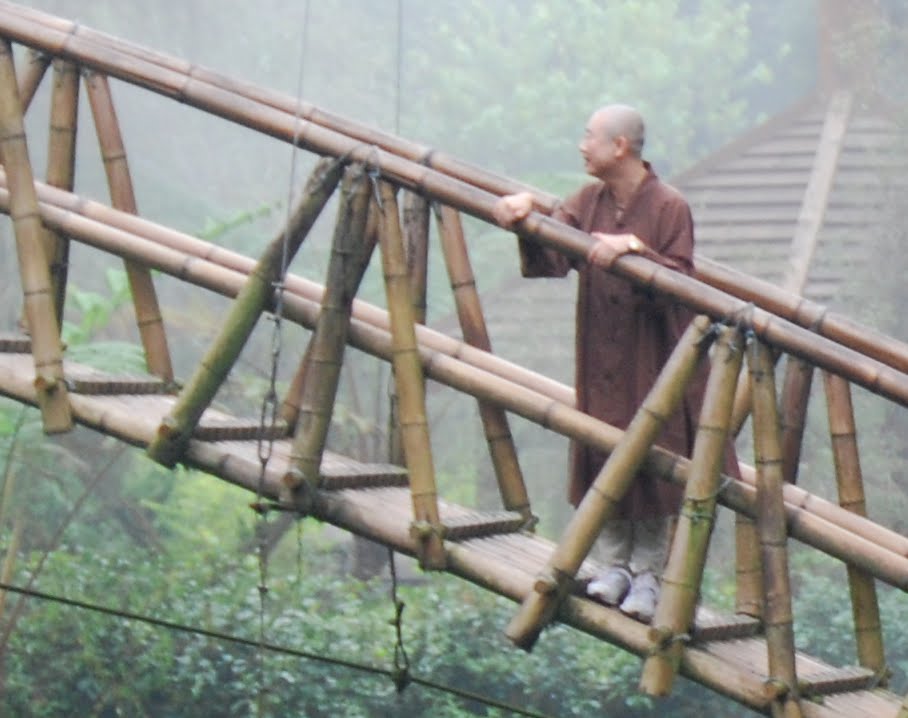
I saw two (Buddhist or Taoist) nuns. One of them (standing on the bank) was taking pictures of the other (standing on the bamboo bridge across the pond). The one on the bridge suddenly shook the bridge by stamping heavily on it, and yelled childishly, "I'm not afraid! I'm not afraid! You see, I am not afraid at all . . . ." Ah, what a young and naive nun! Didn't she know that the bamboo bridge should be used with caution?

忽然,那年輕的尼姑在竹橋上一面跳,一面叫:(台語)「阮嘸驚!阮嘸驚!阮嘸驚!.......」唉呀!好一個少不更事的出家人;竹橋載重有限,可搖晃不得呢!